01 · The short version
Four winners, $25,000, and one clear message.
On October 15, 2026, Contra went live on YouTube, LinkedIn and X to announce the winners of the Lovable Challenge, the small-business booking challenge I took part in with my fictional entry, LEON Mobile Detailing. I wrote about my own experience in What I learned building for the Lovable x Contra Challenge. This article is different. It is a full recap of the announcement itself, so that if you missed the stream or never had time to watch the 21-minute video, you still know exactly what happened, who won, and why.
In short: Sergey took first place ($12,500) with Endorphin, a site and booking system for a large run club in Turin. Lubos took second ($7,500) with DJ Luvable, a DJ booking site that let visitors listen to playlists before booking. Alice took third ($2,500) with UNTITLED, an interactive tattoo booking platform featuring 3D previews and an artist dashboard. Victoria won the Social Media Superstar bonus for the most social impressions, with a playful idea: renting ad space on her golden retriever's harness around New York City.
The message that ran through the whole stream was simple. A booking system alone is not enough. The winners built a believable story, a strong brand, and a reason for someone to book in the first place, and then made booking feel effortless.
02 · How the stream opened
The opening: a host, five judges, and a lot of builders watching.
The stream opened with Dylan from the Contra team welcoming everyone tuning in across LinkedIn, YouTube and X. He thanked everyone who had joined the challenge, then gave a quick introduction to Contra for anyone new: a commission-free creative network where freelancers can connect with other creatives, learn new tools, join challenges like this one, and run their freelance businesses without paying commission.
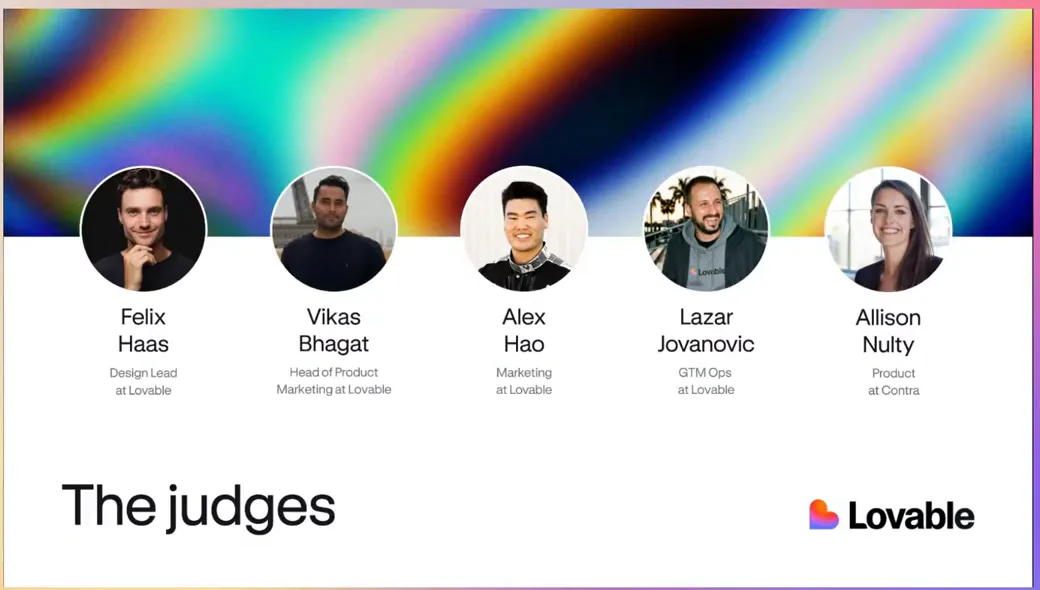
Then he handed over to the judges, one by one. Felix Haas went first. He is based between Stockholm and London and helps lead Lovable's design and brand team, having joined about a year and a half earlier. He said he loves working with founders and building and designing products and brands. A fellow judge jumped in to add that Felix was underselling himself, calling him the architect of much of the Lovable brand.
Next was Vikas Bhagat, who leads product marketing at Lovable from San Francisco. He mentioned that before Lovable he spent five years at Webflow, so he had worked with the Contra community for a long time and was familiar with the kind of work its members build day to day. Alex Hao followed, from Lovable's social team. Alex explained that it was their team who saw all the mentions and builds flowing in across social channels during the challenge.
Lazar Jovanovic introduced himself as part of Lovable's go-to-market operations team, adding that what he does every day is what participants did during the challenge: ship. He said the team had loved reviewing and commenting on everything people built internally. Finally, Allison Nulty represented Contra alongside Dylan. She works on Contra Labs, which partners with creative tools and frontier AI labs to improve how AI works for creatives, and she said it was inspiring to see what the community could build with Lovable.
03 · A quick Lovable update
A short word on Lovable before the results.
Before any winners were named, Vikas gave a brief overview of Lovable for the few people who might not know it: one platform for building websites, custom apps and products through natural language, and even slides. He joked that the Contra team had used Canva for the presentation on screen instead.
He mentioned that Lovable had launched new growth tools the day before, designed to help builders find their first customers, and that more features were coming in the following weeks. He also pointed to the growing number of freelancers and agencies joining Lovable's partner program and building their businesses on the platform. Dylan responded that the submissions had blown his mind, and joked that maybe Contra would use Lovable slides next time.
04 · What the judges looked for
The brief and how entries were judged.
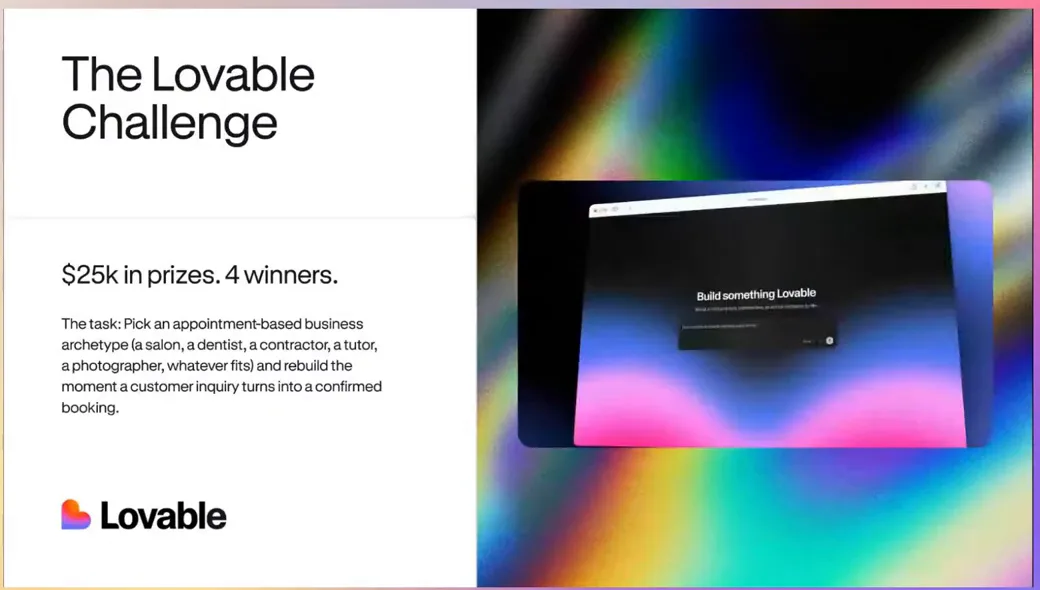
Alex then recapped the brief. Lovable has many users outside the tech bubble, and many of them are local and small businesses using it to organise their work, build a storefront or website, or create internal tools. That was the inspiration for the challenge: pick an appointment-based business and build the whole flow, from a customer's first enquiry to a confirmed booking. The full rules are in the official guidelines.
Alex explained that, as the mix of judges suggested, entries were judged as a whole. The judges looked at the design, the overall user experience and flow, the product itself, and how it was marketed through the assets people created. From the social side, Alex also asked whether the idea was interesting enough to catch on with social media, something people would genuinely gravitate towards, and whether it could help a real business make a bigger mark locally or online.
Alex said the quality was so high that narrowing entries to a shortlist, and then to the final list, was really hard. Dylan added a lighter moment: with such a broad brief, it was funny to see which categories people chose. There were a lot of dog grooming businesses and tattoo parlours. He also called out an escape room entry and said that if there had been an award for best submission video, it would have been his pick.
05 · The prizes
$25,000 in cash, plus visibility.
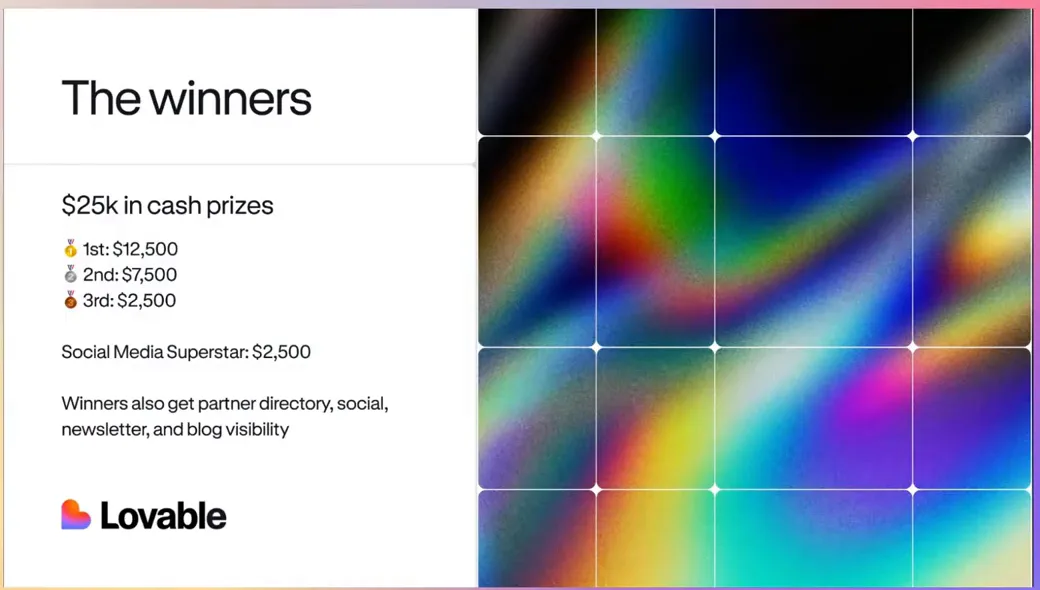
Allison presented the final slide before the winners. The challenge had $25,000 in total cash prizes, and she thanked the Lovable team for putting it together. First place received $12,500, second place $7,500, and third place $2,500. A $2,500 Social Media Superstar bonus rewarded the entry with the most reach on social platforms.
Beyond the cash, winners would also get visibility through Lovable's partner directory, social channels, newsletter and blog. Allison stressed that everyone had done an incredible job, and that these were simply the entries that stood out most.
07 · Third place: Alice
Third place: Alice's interactive tattoo booking platform.
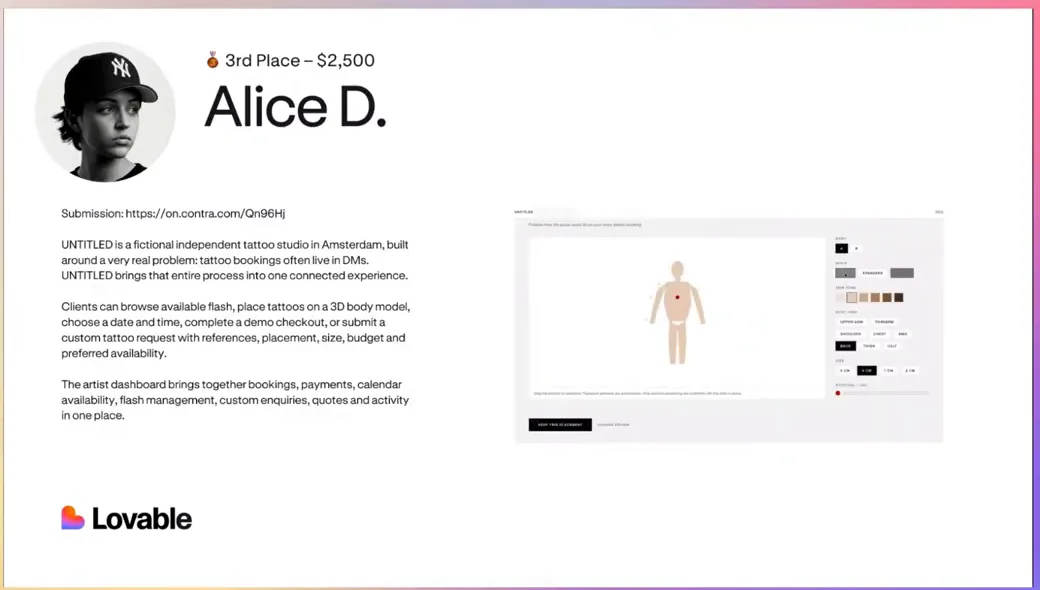
Vikas announced third place: Alice, with a fully interactive tattoo booking platform. He praised its clean, simple design and said it tackled a very common problem. Most tattoo parlours still rely on text messages to book clients. Alice's platform made the process scalable and let customers see what a tattoo would look like on them. Vikas admitted he has no tattoos, and said the preview actually helped him understand what would make sense. He called out the phenomenal interactivity and use of 3D models.
The slide gave more detail. Alice D.'s project is called UNTITLED, a fictional independent tattoo studio in Amsterdam, built around a real problem: tattoo bookings often live in direct messages. Clients can browse available flash designs, place tattoos on a 3D body model, pick a date and time, complete a demo checkout, or send a custom request with references, placement, size, budget and availability. The artist dashboard brings together bookings, payments, calendar availability, flash designs, custom enquiries, quotes and activity in one place. See her Contra submission.
Dylan added that anyone who follows Contra challenges knows Alice's work usually lands on the shortlist or the podium, thanks to her creativity and immaculate attention to detail.
When Alice joined the stream, she said she did not know anyone in the tattoo business, so she had to research the main problems in its booking flow herself. She deliberately went beyond what the brief asked and built an artist dashboard too, giving the project a complete end-to-end experience for both clients and the owner. She said the hardest part was designing the booking flow, which she did manually, and that Lovable helped her understand the core issues users face when a booking needs unusual inputs. She described the build as a real collaboration: Lovable kept suggesting what to add, remove or improve.
08 · Second place: Lubos
Second place: Lubos and the DJ booking site.
Lazar announced second place: Lubos. Speaking as someone who has built hundreds of Lovable projects, he said he looks for three things, and this entry nailed all three.
The first was clarity. As soon as he opened the site, everything he needed was in one place and he was never confused about the flow. The second was consistency: making bold design and motion choices and committing to them all the way. The third was meeting users where they are. The whole point of a booking site is to help a business get booked, and the first question anyone asks when booking a DJ is what their music sounds like. Lubos answered that by letting visitors listen to several playlists before booking, so they could make an informed choice. Lazar noted that DJ bookings, like tattoo bookings, usually happen over texts and calls, while this site handled everything in one place within just a few scrolls.
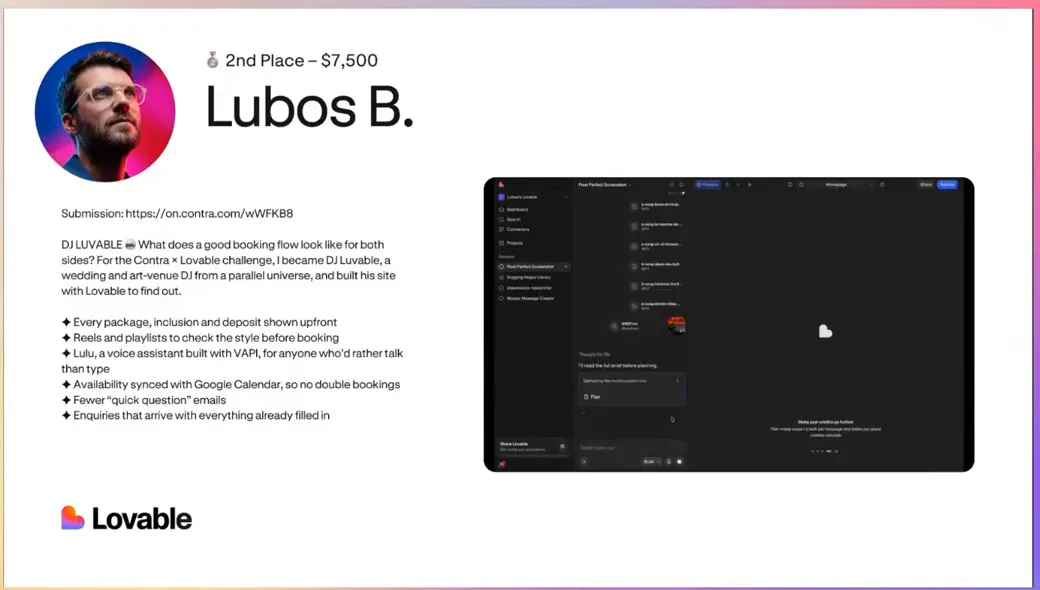
The on-screen slide named the project DJ Luvable: Lubos B. became a wedding and art-venue DJ "from a parallel universe" and built his site with Lovable to explore what a good booking flow looks like for both sides. The slide listed its features: every package, inclusion and deposit shown upfront; reels and playlists to check the style before booking; Lulu, a voice assistant built with VAPI for people who would rather talk than type; availability synced with Google Calendar to prevent double bookings; fewer quick-question emails; and enquiries that arrive with everything already filled in. See his Contra submission.
Dylan then responded to comments in the YouTube chat about booking systems with what may be the most important lesson of the stream. The brief asked for a great booking system, but entrants also had to build the story around it. Without strong brand design and a reason for people to book you, a booking system matters less. The winners went above and beyond to build the whole identity of what they wanted to get booked for. Lubos was not on camera to respond, but Dylan congratulated him and hoped he was watching.
09 · First place: Sergey
First place: Sergey's running and hiking club app.
Felix announced the winner: Sergey. He called the project incredible from both a user experience and an interactive interface point of view. He loved its minimalism and the care in its details, saying everything felt extremely well crafted. He also praised how it combined a modern design approach with real people, giving it a very human touch.
Most importantly, Felix said what makes a product well designed is that people actually use it. While exploring the site, he could see how many people really interacted with it, and how many runs and community events had been organised through the app. That real-world use clearly set it apart.
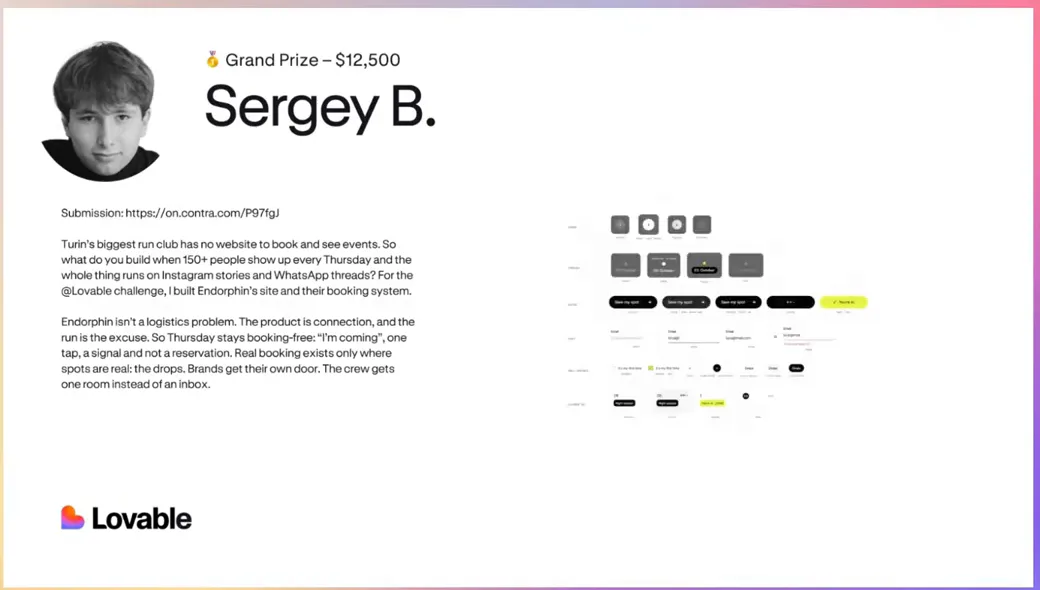
The slide filled in the details. Sergey B. built a site and booking system for Endorphin, which the slide described as Turin's biggest run club: more than 150 people show up every Thursday, but everything ran on Instagram stories and WhatsApp threads. His key idea was that the product is connection, and the run is the excuse. So the Thursday run stays booking-free, with a single "I'm coming" tap as a signal rather than a reservation. Real booking only exists where spots are limited, such as special drops. Brands get their own entry point, and the crew gets one place to manage everything instead of an inbox. See his Contra submission.
When Sergey joined, he explained that the project started simply. He went on a social run with an endurance club where he lives, and noticed they had no booking system. They had no control over who turned up, and no way to reserve a spot for a run or a hike. Because he was part of that community, he understood how things worked from the inside. He admitted he was not sure he would win, because the other entries were so strong, so the result was a real surprise. Dylan congratulated him and said he always enjoys Sergey's posts on Contra across his different disciplines.
10 · How it closed
The closing: ties, honourable mentions, and what is next.
Dylan wrapped up by acknowledging everyone else who entered. He said the shortlist was long, the submission list even longer, and the judges deliberated a lot, with ties at the top that needed tiebreakers. He mentioned he might post his personal favourites on Contra, and gave a shout-out to one entry from an agency he found especially impressive.
He praised everyone for putting their creativity out there publicly, calling it a brave accomplishment. For those who felt strongly about entries that did not place, he suggested turning them into templates for future projects.
Vikas closed by congratulating everyone again and pointing to what was next: joining the Contra community and following Lovable there, exploring Lovable's partner program with its expert tracks for freelancers, agencies and businesses built on Lovable, and joining the Lovable community for education, peer support, and contact with team members like Lazar and Felix. Dylan thanked the judges and participants, and hoped to see everyone in a future challenge.
11 · What the winners had in common
What the four winning entries had in common.
Looking at all four winners together, a few patterns stand out. Each one started from a real, specific situation rather than a generic business. Sergey built for a club he actually runs with. Victoria built around her own dog and the attention he already gets. Alice and Lubos picked industries where booking still happens through texts and calls, then designed around the exact question a customer asks before booking: what will this tattoo look like on me, and what does this DJ sound like?
Each one also had a strong identity. The judges kept returning to bold, consistent design, careful detail, and a human feel. Two winners went beyond the customer side: Alice built an owner dashboard, and Sergey's app showed real community use. And all of them were easy to explain in one sentence, which matters when entries are also judged on how well they travel on social media.
For me, this matched a lot of what I wrote in my own reflection on LEON. My entry had a deep booking, tracking and business workflow (see the LEON case study), but the winners showed how much story, brand and real-world proof add on top of features.
12 · Lessons for small businesses
What this means if you run an appointment-based business.
You do not need to enter a challenge to use these lessons. If customers book you for appointments, the winners show what a good booking experience looks like: answer the question customers ask before booking, right on the page. Show your work, your sound, your prices, or your schedule. Keep the whole flow in one place instead of scattering it across messages and calls. And make your brand clear enough that people want to book you, not just that they can.
If you want a booking flow like this built for your own business, I build custom web apps and business websites with Lovable. New to the platform? Start with What is Lovable?, or get in touch to talk through your project.
13 · References
Sources and further reading
14 · Common questions
About the winners
Who won the Lovable x Contra Challenge?
Sergey B. won first place with Endorphin, a site and booking system for a Turin run club. Lubos B. placed second with DJ Luvable, Alice D. placed third with the UNTITLED tattoo studio platform, and Victoria L. won the Social Media Superstar bonus.
How much were the prizes?
There was $25,000 in total cash prizes: $12,500 for first, $7,500 for second, $2,500 for third, plus a $2,500 Social Media Superstar bonus. Winners also got visibility through Lovable's partner directory, social channels, newsletter and blog.
Who judged the challenge?
The judges were Felix Haas (Design Lead, Lovable), Vikas Bhagat (Head of Product Marketing, Lovable), Alex Hao (Marketing, Lovable), Lazar Jovanovic (GTM Ops, Lovable) and Allison Nulty (Product, Contra). Dylan from Contra hosted.
How was the Social Media Superstar chosen?
The team looked at total impressions on social posts made during the challenge, reviewing thousands of posts.
Did LEON Mobile Detailing win?
No. LEON, my fictional entry, did not place. I share what I learned in a separate article.

06 · Social Media Superstar: Victoria
Social Media Superstar: Victoria and Hardy.
Alex announced the first award. For the Social Media Superstar, the team looked at total impressions on social posts, scanning through literally thousands of posts made during the challenge. The winner was Victoria.
The slide shown on stream named her as Victoria L. and called the project Hardy Ad. It explained how it works: brands pick a spot on a 3D model of Hardy, upload their sticker, choose their weeks, and pay in one go. The booking confirms itself, with no messages, invoices or chasing. The slide linked her Contra submission.
Dylan pointed out that Victoria's entry had also made the overall shortlist, not just the social award. Her idea: brands could buy ad space on her dog's harness as he walked around New York City. Dylan called it a lot of fun, then brought Victoria onto the stream.
Victoria appeared with her golden retriever, Hardy, who joined the celebration on camera. She said she was happy and a little surprised to win. She explained that Hardy goes almost everywhere with her in New York, to coffee shops and restaurants, and that people constantly stop to say hello to him. One day she wondered what would happen if brands could put stickers on his harness, since he already gets so much attention. That is how the idea started.
She described testing the idea in Lovable as a chance to think outside the box, asking the agent what she could do to make it real. She said she tries AI tools daily for work, but Lovable impressed her so much that she now uses it to test ideas, prototype quickly, and discuss them with her team. Dylan, also based in New York, joked that he would bump into the pair one day, and mentioned a small California town whose mayor is a golden retriever named Max.